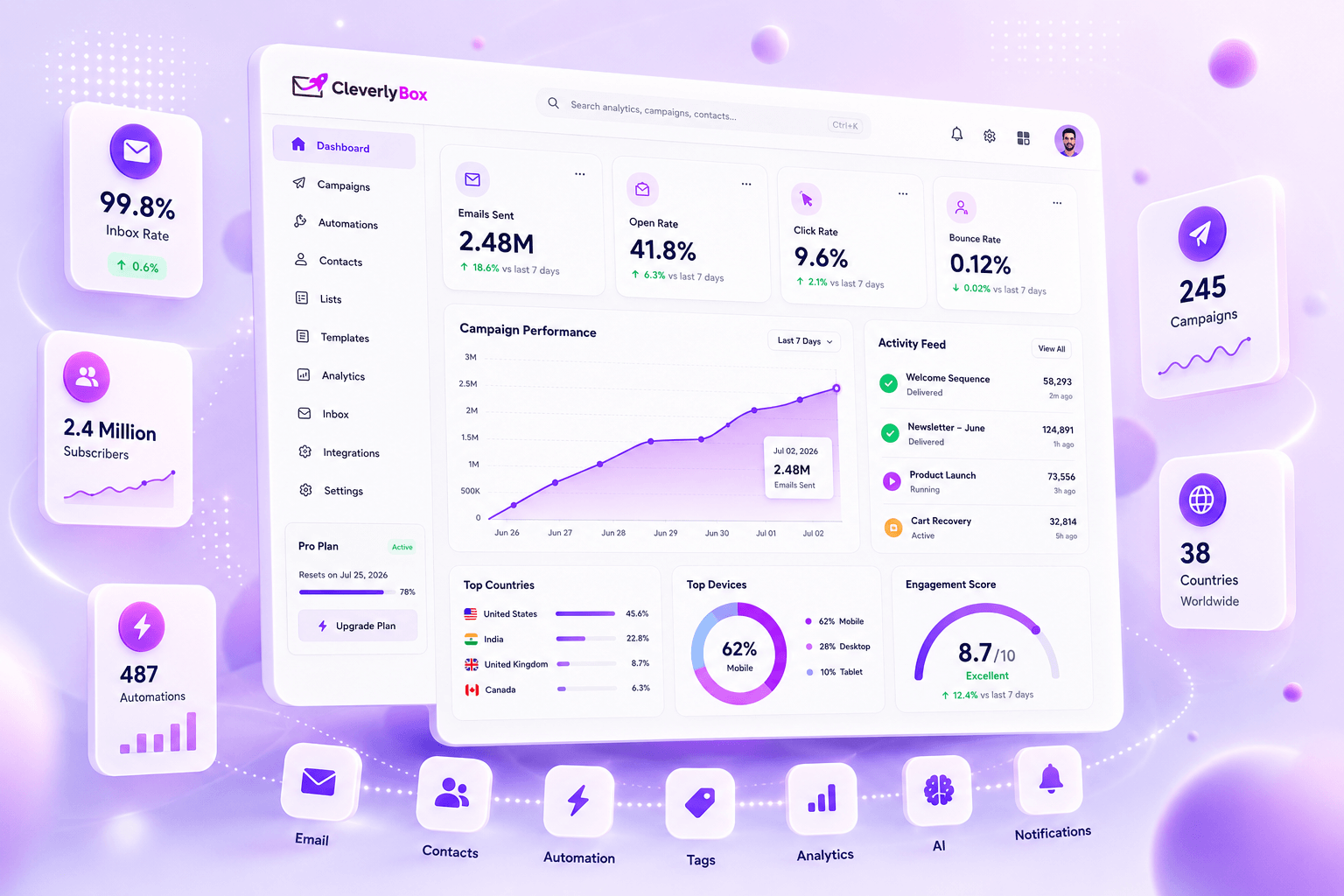
CleverlyBox Use Cases
USE CASES

One platform for transactional + marketing. One sender database. One bill

Mailgun for the password resets. Mailchimp for the newsletter. Customer.io for the lifecycle drips. Three sender databases that never talk. Three deliverability dashboards. Three bills that go up every quarter. CleverlyBox is the version where the marketing team and the engineering team finally use the same tool and the customer record actually unifies.

The SaaS
lifecycle profile

Built for organizations that take email, compliance, and deliverability seriously — at scale.

Secure by design
Data stays with you
Audit ready
Stage

Series-Seed → Series-B

Email Volume

100K–5M emails / month

Current spend

$300 – $2,000 / month combined

Stack

Mailgun + Mailchimp + Customer.io / Intercom

Enterprise Environment

You're a SaaS product or marketing lead. You ship transactional from Mailgun, marketing from Mailchimp, lifecycle from Customer.io, and you've never confidently answered "who has been emailed how many times this month?" The customer profile is split across three systems. The bills compound. Engineering owns one, marketing owns the others, and nobody owns the deliverability outcome.
Five things splitting your sender
database is costing you

~2× the cost
Two sending platforms. Two bills.

Mailgun for transactional. Mailchimp for marketing. Each has its own per-1K cost, its own minimum, its own "growth" tier. You're paying twice for fundamentally the same SMTP capability.

No unified profile
The customer record splits at the boundary

Mailgun knows the password reset went out. Mailchimp knows they opened the newsletter. Customer.io knows they hit the upgrade prompt. None of them know all three. Your support team certainly doesn't.

$200/mo+ in glue
Sync infrastructure is a separate project.

You either build a sync service (eng cost), pay Segment /RudderStack ($200+/mo), or run it manually with Zapier and pray. The "unified customer view" promise is mostly Zapier zaps and CSV exports.

Three dashboards
Three deliverability dashboards. None complete.

Each tool reports its own bounces, complaints, opens. Combined view doesn't exist. When deliverability drops, nobody can isolate which sending pool is the problem until customer-success starts pinging the team.

Per-MAU pricing
Customer.io / Intercom price per active user

Every signup costs you. Every dormant trial costs you. Hit a viral month, your bill jumps. The pricing model punishes the freemium funnel exactly when you most want to nurture it.

Cold-shoulder migration
Each tool's lock-in compounds

Migrating off Mailgun is one project. Off Mailchimp is another. Off Customer.io is a quarter-long initiative. You can't even consolidate to one of them without losing data along the way. CleverlyBox is one migration that ends three lock-ins

One platform. Multiple sending pools. One unified subscriber DB.

01 Pool architecture

Dedicated transactional pool. Separate marketing pool. Same customer record

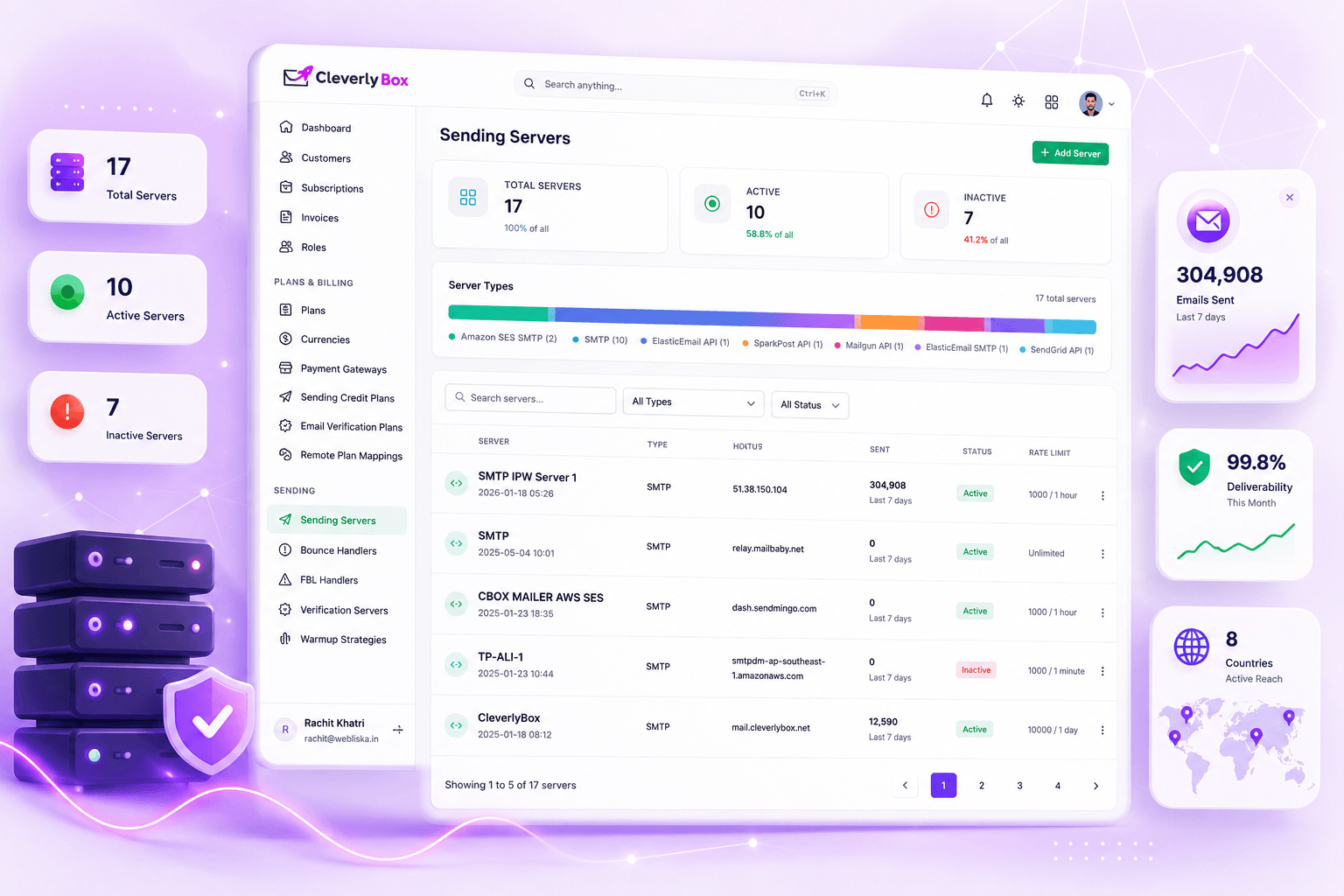
CleverlyBox supports multiple sending servers, sending groups, and per-list send-server overrides. Configure a high-priority transactional pool (your fastest SES queue) for password resets and order receipts. Configure a separate marketing pool (a different SES region, different IPs, lower priority) for newsletters and lifecycle drips. Both pools, one subscriber database, one engagement record.

  • Per-list send-server override — system emails go to your transactional pool by default
  • Multiple SES regions / multiple SES sub-accounts as separate pools manage IP reputation per pool
  • Failover routing: if transactional SES has issues, swap to SendGrid in seconds
  • Single customer record: every send (transactional + marketing) attaches to the same subscriber
02 Product → automation

Every product event becomes an automation trigger.

Your product fires events: user_signed_up, trial_started, plan_upgraded, subscription_canceled, feature_used. Pipe each into a CleverlyBox API trigger via the webhook URL — no glue layer, no Segment subscription, no per-MAU pricing. The merge tags read your event payload, so emails personalize on the actual product state.

  • One webhook URL per automation — paste into your event bus or Stripe webhook endpoint
  • HMAC verification on inbound — replay-protected, signature-verified
  • Payload data flows into merge tags: {{plan_name}}, {{trial_days_left}}, {{usage_count}}
  • Conditional branches on payload values — different emails for different segments
  • Webhook history + retry + dead-letter queue — debugging-grade observability
03 Stripe events

Stripe webhook → CleverlyBox automation. The simplest revenue loop you'll ship

Stripe's webhook system fires on every billing event: customer.subscription.created, .updated, .deleted, invoice.payment_failed, charge.dispute.created. Point each at a CleverlyBox automation. Welcome flow on subscription created. Dunning flow on payment failed. Win-back flow on subscription deleted. The lifecycle marketing piece becomes engineering-flat — no marketing-eng joint project to ship a flow.

  • Stripe → CleverlyBox direct webhook integration (Stripe events become flow triggers)
  • Failed payment dunning sequence — 3 emails over 7 days, auto-suppress on payment success
  • Subscription canceled → 30-day wait → win-back flow with new feature recap
  • Charge dispute fired → support team alert via Slack webhook (CleverlyBox can fan-out)
04 Segmentation

Segment by plan. By usage. By recency. By role

Custom fields capture what your product knows: plan tier, monthly active users, last-login-date, role-in-workspace, billing-status. Segments compose freely: "Pro plan + DAU last 7 days + admin role" becomes one click. Saved segments are first-class triggers — flows fire when a user enters or exits a segment.

  • Plan tier as a custom field, kept fresh by your Stripe webhook
  • Engagement scoring via per-event custom fields (last_action_at, action_count_30d)
  • Saved segments trigger automations — entering a "churn-risk" segment fires a save flow
  • Segment math runs in seconds even at 5M subscribers

Mailgun + Mailchimp + Customer.io = $1,200+/mo.
CleverlyBox = $79 once

Function CleverlyBox Pro Best Today's stack (annual)
Transactional sending (1M emails/mo) SES: ~$120/yr Mailgun: ~$1,200/yr
Sending cost (4 sends/mo to 75K) ~$36/mo SES included (with throttle)
Marketing broadcasts (50K-list, weekly) included on platform Mailchimp: ~$3,000/yr
Lifecycle automation (per-MAU) included on platform Customer.io: ~$3,000–6,000/yr
Segment / sync layer native (one DB) Segment Free → Paid: ~$1,200/yr
AI subject lines included (your OpenAI key) Jasper/Copy.ai: ~$600/yr
AI subject-line writing included (your OpenAI key) $$ add-on
Verification included (your provider key) ZeroBounce: ~$300/yr
Year-1 total $79 + ~$120 SES ~$9,300–12,300

From SaaS teams that consolidated

"We were running Mailgun + Mailchimp + Customer.io. Combined: $1,180/month. We consolidated to CleverlyBox Pro + SES in 5 weeks. Combined now: $79 once + $32/month SES. Same flows, better deliverability dashboard, one customer record."

VK
Vikram K.

Head of Growth · B2B SaaS · $4M ARR

"The unified subscriber DB is the unlock no-one talks about. Our support team went from 'wait, did marketing send him an email this week?' to 'yes, the welcome flow fired Tuesday at 11.' One source of truth."

AM
Anya M.

VP Product · Vertical SaaS

"Stripe webhook → CleverlyBox automation took 20 minutes to wire. Our dunning sequence used to be a manual cron job. Now it's a flow with a dead-letter queue and full audit trail. Engineering reclaimed a quarterly cleanup task."

JR
Jamie R.

Lead Engineer · API SaaS

Operator quotes from launch cohort, recomposed for privacy.

FAQ

SaaS team questions.

Yes. CleverlyBox uses Amazon SES under the hood for transactional pools, which is the same SMTP backbone Mailgun and most ESPs use. Latency to first delivery attempt is sub-second. The send queue is Laravel Horizon-backed and horizontally scalable. For most SaaS volumes (under 10M emails/month), you won't see a meaningful latency difference — SES is fast.

Configure two separate SES sub-accounts (or two SES regions, or two SendGrid sub-accounts) and assign each to a sending pool in CleverlyBox. Tag your transactional list with the high-priority pool, your marketing list with the standard pool. Each pool's IPs are isolated — a marketing-list bounce never affects your transactional reputation. This is the same pattern Mailgun and SendGrid recommend internally.

Yes. CleverlyBox is built on Laravel Horizon (queue workers), horizontally-scalable on the data plane, and the underlying Amazon SES has functionally infinite send capacity (your throughput cap is your AWS account quota, which AWS raises on request). Deployments handling 10M+ messages/month run on standard infrastructure. If you're north of 50M/month, talk to support about dedicated infrastructure recommendations.

Two patterns. Pattern 1: webhook-on-event — your product fires an HTTP request to CleverlyBox's API on every relevant event (signup, upgrade, churn). Pattern 2: scheduled batch — your job runs nightly and POSTs subscriber updates via the bulk-update endpoint. Most teams use pattern 1 for state changes and pattern 2 for usage-counter refreshes. No Segment / RudderStack required.

Yes. CleverlyBox's automation engine supports the same primitives Customer.io does: triggers (event-driven, time-driven, segment-entry), waits (any duration), conditional evaluation (any field or computed value), and multi-branch flows. Building a parallel of a Customer.io flow takes 30–60 minutes per flow. The visual canvas is closer to ActiveCampaign's than Customer.io's editor — most teams find it faster.

CleverlyBox is self-deployable, so the SOC 2 question is about your deployment, not ours. The reference architecture (Laravel 12 + AWS SES + standard EC2/RDS) is fully SOC 2 type II compatible. Audit-log retention, encryption at rest, and access controls are configurable. Most SaaS teams stand up CleverlyBox in their existing SOC-2-scoped AWS account, which means it inherits the certification posture rather than requiring a separate vendor review.

Yes. CleverlyBox supports role-based access: marketing team gets campaign-builder access, engineering gets API + sending-config access, support gets read-only. Audit logs track who changed what. Different lists, different automations, different sending pools — same platform, same customer record, separated workflows. This is the operational shape most SaaS teams want.

One platform. Two pools. One bill. $79 once.

CleverlyBox Pro consolidates your Mailgun, Mailchimp, and Customer.io stack into one subscriber database — for the cost of a month of any of them. Lock the lifetime price before the founders' cohort closes.

One-time payment 30-day money-back guarantee Cancel anytime