CleverlyBox Use Cases
USE CASES

Klaviyo's revenue cut is a tax you don't have to keep paying

Klaviyo took 30% of every email-attributed dollar. Then they raised the per-contact price. Then they added an SMS upsell. Then a "growth" tier. Meanwhile, your cart-abandon, post-purchase, browse-abandon, and win-back flows are doing the same eight things they did three years ago. CleverlyBox runs all of them — for $79 once, on your own Amazon SES.

The store
operator profile

Built for organizations that take email, compliance, and deliverability seriously — at scale.

Secure by design
Data stays with you
Audit ready
Annual revenue

$200K – $5M / year

Email list size

10K – 200K subscribers

Current ESP spend

$49 – $149 per month

Stack

Shopify / Woo + Klaviyo + Postscript

Enterprise Environment

You run a D2C brand. Email is 25–40% of monthly revenue. Klaviyo's invoice is now bigger than your Shopify Plus invoice and the gap is widening. You'd swap tomorrow if you trusted the deliverability. CleverlyBox is the swap that doesn't sacrifice the deliverability — because the sending happens on your own SES.
Four ways the ecommerce ESP economy is
rigged against you

+30% of attributed revenue
Klaviyo's pricing scales with your win.

The bigger your list, the bigger the cut. The better your flows perform, the more they extract. You're not paying for software — you're paying a percentage tax on revenue you generated.

$60–200/mo extra
SMS, reviews, and back-in-stock are separate add-ons

Email + SMS + reviews + loyalty + post-purchase surveys = four to six monthly invoices. Each tool wants its slice. Each integration is one more failure point.

$0.30/contact/mo
List bloat costs you whether you send or not

50,000 inactive contacts cost the same as 50,000 active ones. You should be cleaning them. You don't, because Klaviyo charges you to even know if they're alive (verification is extra).

Locked-in flow exports
Migration off Klaviyo is engineered to be painful.

The flow JSON doesn't export cleanly. Klaviyo-specific merge tags don't translate. The 90-day engagement history disappears. By design, leaving costs more than staying — until the bill itself becomes unbearable.

$300+/mo at 50K + sends
Send volume + list size both bill, double-counting growth

Klaviyo charges per contact AND throttles your sends if you exceed plan limits. Pay for the list size. Then pay again to actually use it. The pricing model assumes you won't read the fine print.

Forever recurring
There is no version of this where the bill ends

Your store could be doing $5M/yr or $500K/yr — Klaviyo grows in lockstep with you in the good times and doesn't shrink in the bad times. CleverlyBox is the version where the bill ends.

At 75K subscribers, you save $4,800/yr — and that's before the SMS line item

Klaviyo at 75K contacts × 1 year

$5,460

CleverlyBox Pro lifetime + SES

$79 + ~$540/yr SES

Line item CleverlyBox Pro Best Klaviyo Email
Platform cost (annual, 75K subs) $79 (one-time) $5,460
Sending cost (4 sends/mo to 75K) ~$36/mo SES included (with throttle)
List verification included (your provider key) ~$25/mo extra
Form / popup builder included included on higher tier
Post-purchase automations included included
Browse-abandon included included on higher tier
AI subject-line writing included (your OpenAI key) $$ add-on
Year-1 totalr ~$511 ~$5,760
Year-3 cumulative ~$1,375 ~$17,280

From Shopify webhook to CleverlyBox automation, in 12 minutes.

01 Webhook → automation

The API trigger is the keystone of every ecommerce flow

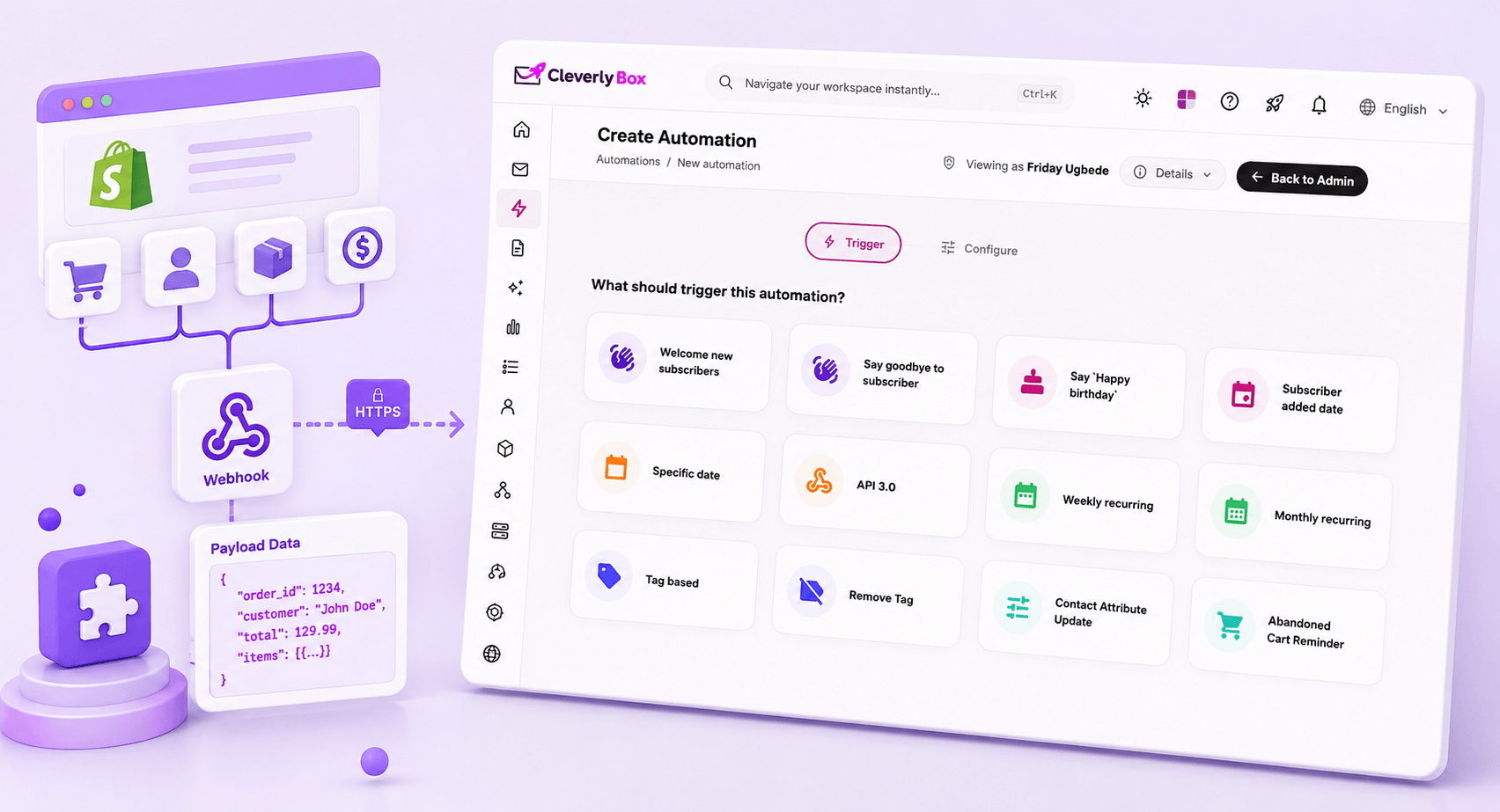
CleverlyBox's API trigger lets any HTTP webhook fire any automation — and pass payload data into the email's merge tags. Shopify's checkouts/abandoned, orders/paid, and orders/fulfilled webhooks plug straight in. WooCommerce's webhook system works identically. No Zapier middleware required.

  • Each automation gets a unique webhook URL — paste it into Shopify Admin → Settings → Notifications
  • Cart, customer, and line-item data passes into the email as merge tags ({{cart_total}}, {{product_name}}, {{first_name}})
  • Conditional branches read the payload — different flows for different cart values, product categories, or repeat-vs-first-time buyers
  • HMAC verification on the webhook ensures only your store can trigger the flow
02 Segmentation

Slice the list by LTV, by category, by recency

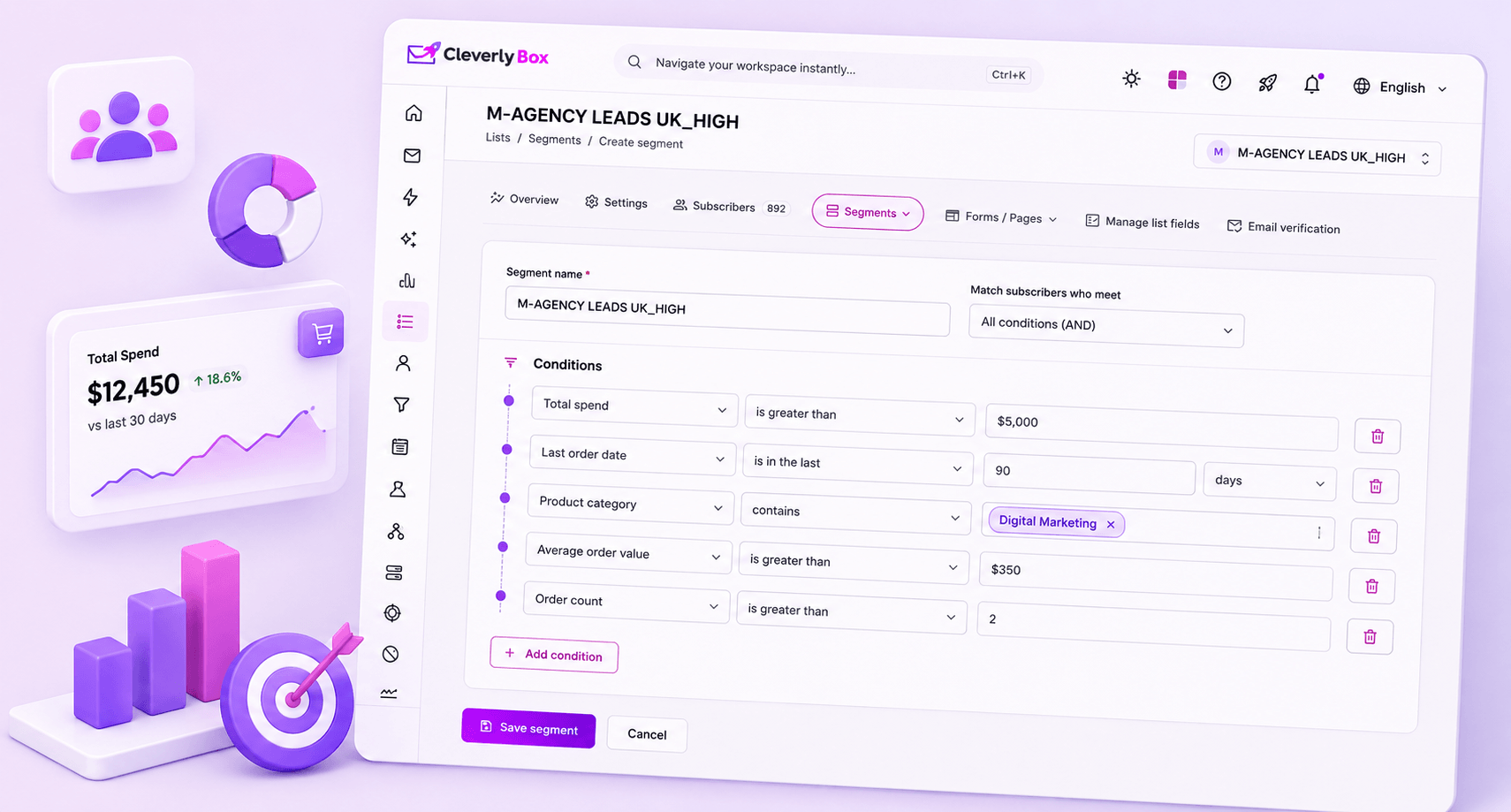
Custom fields capture the data Klaviyo's flows depend on total spend, last-order-date, product-category-pref, average-order-value. Saved segments recalculate every send. Build a "VIP $500+ customers" segment once, and every campaign automatically targets it fresh.

  • Custom fields update via the order-paid webhook — every purchase enriches the profile
  • Segment combinators: AND/OR/NOT across any field — no SQL needed
  • Saved segments work as triggers: "added to VIP segment" → fire VIP welcome flow
03 Bidirectional sync

Webhooks both directions. Your warehouse stays the truth

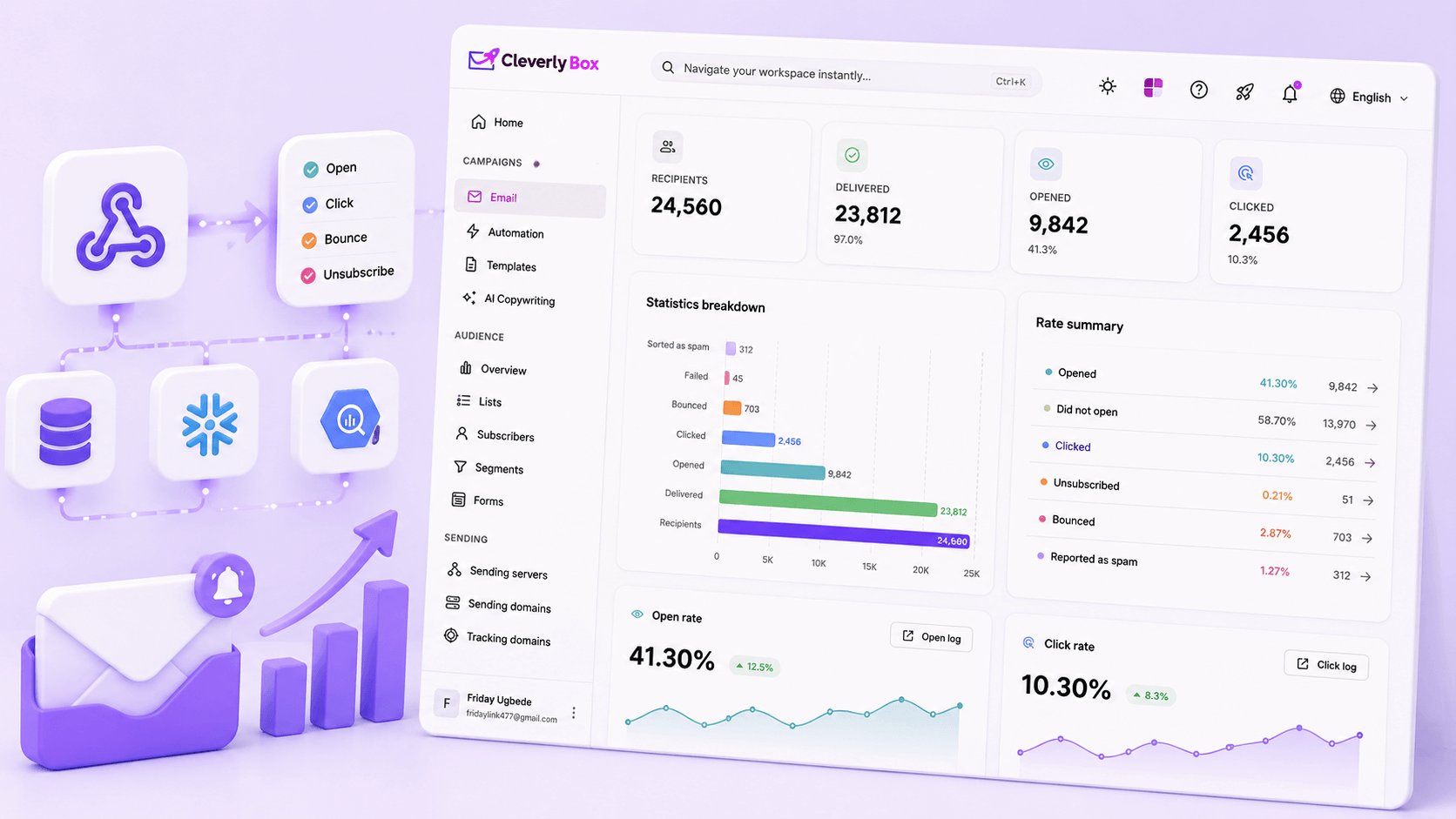
CleverlyBox emits webhooks for opens, clicks, bounces, unsubscribes, and complaints. Pipe them to your Shopify customer notes, your Klaviyo replacement profile, your Snowflake / BigQuery warehouse, or your CDP. Email engagement data goes back into your purchase model without Klaviyo's $200/mo BI add-on.

  • Webhook events: open, click (with URL), bounce (hard/soft), unsubscribe, complaint, signup, list-add
  • HMAC-signed payloads — verifiable on your end, replay-protected
  • REST API for subscriber CRUD, custom field updates, list moves — bidirectional sync without Zapier

Six pre-built ecommerce automations, ready to wire to your store

Every D2C operator runs roughly the same six flows. Each one is a workflow template inside CleverlyBox. Connect your store webhook, drop in your branding, and ship.

Cart abandonment

Trigger: cart-not-converted webhook from your store at the 1-hour mark. Three-email cadence: 1h reminder → 24h discount nudge → 72h "last call" with social proof. Dynamic line-item rendering pulls from the cart payload..

Recovers ~10–18% of carts

Post-purchase upsell

Trigger: order-paid webhook. Day 1 thank-you + setup tips. Day 5 cross-sell of related products. Day 14 review request with one-click rating embed. Day 30 replenishment nudge for consumables.

+12% LTV in 90 days

Browse abandonment

Trigger: viewed-product webhook from your tracker. 4-hour wait, then "you were looking at this" email with product details, related items, and a single CTA back to the PDP. Conditional: skip if a purchase already happened.

3–6× the open rate of broadcast

Win-back lapsed buyers

Trigger: monthly recurring evaluation. Segment: bought ≥1 time, last order ≥120 days ago. Three emails: "we miss you" → "here's 15% off" → " last chance + portfolio of new arrivals." Auto-suppress on next purchase.

Reactivates 4–8% of lapsed buyers

Birthday + anniversary

Built-in birthday + anniversary triggers fire on the date stored in the subscriber's custom field. One email, one discount, one CTA. The simplest highest-converting flow you'll ship.

15–22% conversion on the click

Replenishment reminders

Trigger: order-paid webhook + product-category metadata. Wait N days based on your average reorder cycle for that SKU class. Send the "time to restock?" email with a one-click reorder link.

For consumables: massive repeat-purchase lift

Klaviyo → CleverlyBox over a 14-day parallel-running window.

Don't rip-and-replace mid-quarter. Run both systems for two weeks, validate the new flows match Klaviyo's revenue numbers, then pull the plug. Here's the sequence.

DAYS 1–3 · SETUP

Stand up the platform.

  • Buy CleverlyBox Pro lifetime ($79)
  • Connect Amazon SES — request production access
  • Add your sending subdomain (mail.shop.com) paste DNS records
  • Verify SPF / DKIM / DMARC pass
  • Set the tracking subdomain (track.shop.com) for HTTPS click links
DAYS 4–6 · LIST

Migrate the list with full custom-field mapping

  • Export Klaviyo profiles as CSV (include custom properties)
  • Map fields: lifetime_spend, last_order_date, average_order, top_category
  • Run verification on import (catch the dead Klaviyo profiles)
  • Recreate your Klaviyo segments using CleverlyBox segment builder
  • Sanity check: subscriber counts match within 1–2%
DAYS 7–9 · FLOWS

Rebuild the six core flows

  • Cart-abandon: wire Shopify checkouts/abandoned webhook
  • Post-purchase: wire orders/paid webhook
  • Browse-abandon: wire your tracker's view-product event
  • Win-back, birthday, replenishment: native CleverlyBox triggers
  • Send each through to a test seed list — verify rendering + merge tags
DAYS 10–14 · PARALLEL

Run both systems. Validate. Cut over.

  • Send broadcasts from CleverlyBox to a 50% list slice (A/B reputation test)
  • Watch deliverability + revenue attribution side-by-side
  • If CleverlyBox metrics match or beat Klaviyo, route 100%
  • Disable Klaviyo automations one at a time as confidence builds
  • Day 14: cancel Klaviyo billing. Save the export as backup.

From store operators who made the swap.

"Klaviyo was billing us $640/month. We migrated 78K subscribers to CleverlyBox over two weekends. Cart-abandon revenue went up — partly because the deliverability is better on dedicated SES, partly because the new templates are sharper. We're saving $7,500/yr and the flows perform better."

AK
Anil K

Skincare D2C · 78K subs · $1.4M ARR

"The webhook trigger from Shopify is the cleanest version of this I've seen. We dropped Zapier in the same week. Fewer moving parts, faster fires, no monthly Zap tax."

EC
Elena C.

Apparel D2C · Shopify Plus

"What sold me: the segment builder is actually faster than Klaviyo's. I rebuilt 11 segments in 90 minutes. Then I spent the rest of the day with my partner because I wasn't reading the Klaviyo invoice anymore."

MT
Marcus T.

Coffee subscription · $890K/yr

Operator quotes from launch cohort, recomposed for privacy.

FAQ

E-commerce operator questions.

Webhooks. Shopify's native webhook system covers every event you'd want to trigger on — checkouts/abandoned, orders/paid, orders/fulfilled, customers/create, customers/update. You paste the CleverlyBox webhook URL into Shopify Admin → Settings → Notifications, and the flow fires within seconds. No app, no app-store fees, no extra OAuth surface, no Klaviyo-style platform lock-in. Same pattern works for WooCommerce, BigCommerce, and Shopware.

Performance is determined by three things: deliverability (which is better on a dedicated SES IP than on Klaviyo's shared pool), the email itself (yours, copy-pasted across), and the timing logic (which you'll rebuild identically). Most operators see equal or slightly better cart recovery in the first 30 days, primarily because the new dedicated IP improves Gmail inbox placement.

Yes. The webhook payload from Shopify includes line items, prices, and product images. Use them as merge tags directly: {{line_items[0].name}}, {{line_items[0].price}}, {{line_items[0].image_url}}. For broadcast campaigns with dynamic catalogs, you can use the API to inject product data at send-time or pre-render a personalized HTML block per segment.

CleverlyBox is email-first. SMS isn't built in. Most operators either keep SMS on Postscript / Attentive (which is fine those tools earn their keep), or migrate SMS separately to a Twilio-direct setup. The CleverlyBox saving is large enough that the SMS line item becomes irrelevant you're net-positive even with Postscript still running.

CleverlyBox gives you click-through and conversion-event tracking via webhooks back to your store. Revenue attribution is calculated by your store (Shopify's "marketing analytics" report shows email-attributed revenue when you tag campaigns with UTM parameters — which CleverlyBox auto-appends). For more sophisticated attribution, pipe the click webhook into your analytics warehouse and join against orders. This is how the largest operators run attribution anyway Klaviyo's number is a black-box approximation.

SES suspension is rare and almost always preceded by complaints/bounces above AWS's thresholds. CleverlyBox's deliverability dashboard surfaces those signals before AWS does, so you can pause campaigns and clean before AWS notices. As a backup, configure SendGrid or Mailgun as a failover provider (CleverlyBox supports multi-provider sending pools) — if SES ever has an issue, sending switches automatically.

CleverlyBox includes a form builder with embed snippets, popup triggers, and double opt-in. Most operators keep their Klaviyo popups running for 30 days post-migration (they still capture to your Shopify customer DB), then swap the embed to the CleverlyBox snippet at month-end. Both approaches work the swap is a one-line code change.

Stop paying a percentage on revenue you generated

CleverlyBox Pro at $79 lifetime runs every ecommerce flow Klaviyo runs — on infrastructure you control. The migration takes a fortnight, parallel-run safely, and ends with the bill turned off forever.

One-time payment 30-day money-back guarantee Cancel anytime