CleverlyBox - Spintax Feature
EMAIL INFRASTRUCTURE

Send 50,000 unique emails — without writing 50,000 emails.

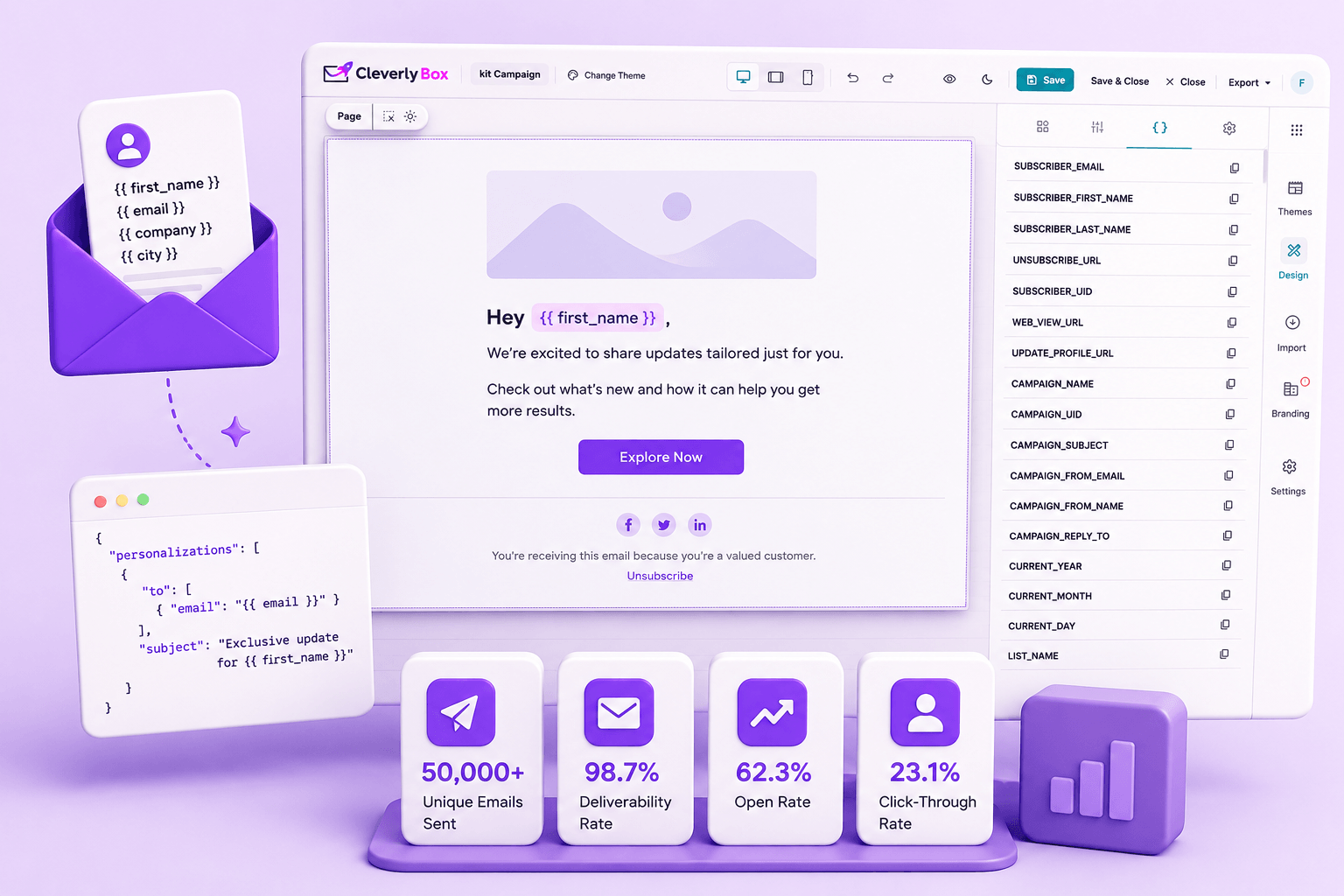
{Hey|Hi|Hello} {{first_name}} — every recipient gets a unique word-for-word combination. Nested variations supported. Subject lines, body copy, HTML — all spintax-aware. The result: ISP filters can't fingerprint your send as a "blast." Deliverability climbs. Open rate climbs. And you wrote one email.
1-1,024

Variants per send

Unique combinations

3

Steps to spin & send

+15-30%

More replies on average
Why identical sends die in spam

ISPs see 50,000 byte-identical emails and call it a blast.

Modern spam filters fingerprint email content. If 50,000 messages share the same subject, body, and HTML same byte hash that's the textbook signature of a bulk blast. Filters dump them into Promotions, then Spam, then block. Spintax breaks the pattern at the source: every recipient gets unique content.

Identical content = filter signal

Gmail, Yahoo, and Outlook all flag content fingerprints. When 10,000 emails arrive with identical subject + body within 5 minutes, the filter learns: this is a blast. Next send, it's pre-classified before opening.

"Subject fatigue" in saturated lists

If your list has seen "Limited time offer" 14 times this quarter, the 15th send tanks. Subject-line variation per recipient — even subtle — keeps each send feeling fresh and bumps opens 5–15%.

Two variants is rarely enough

Traditional A/B testing splits the list into 2 or 3 versions. Spintax with 4 alternatives across 5 lines = 1,024 unique combinations. That's not A/B — that's a-z, automatically, with no extra setup.

SPINTAX ENGINE

Curly braces. Pipe separators. That's the entire language.

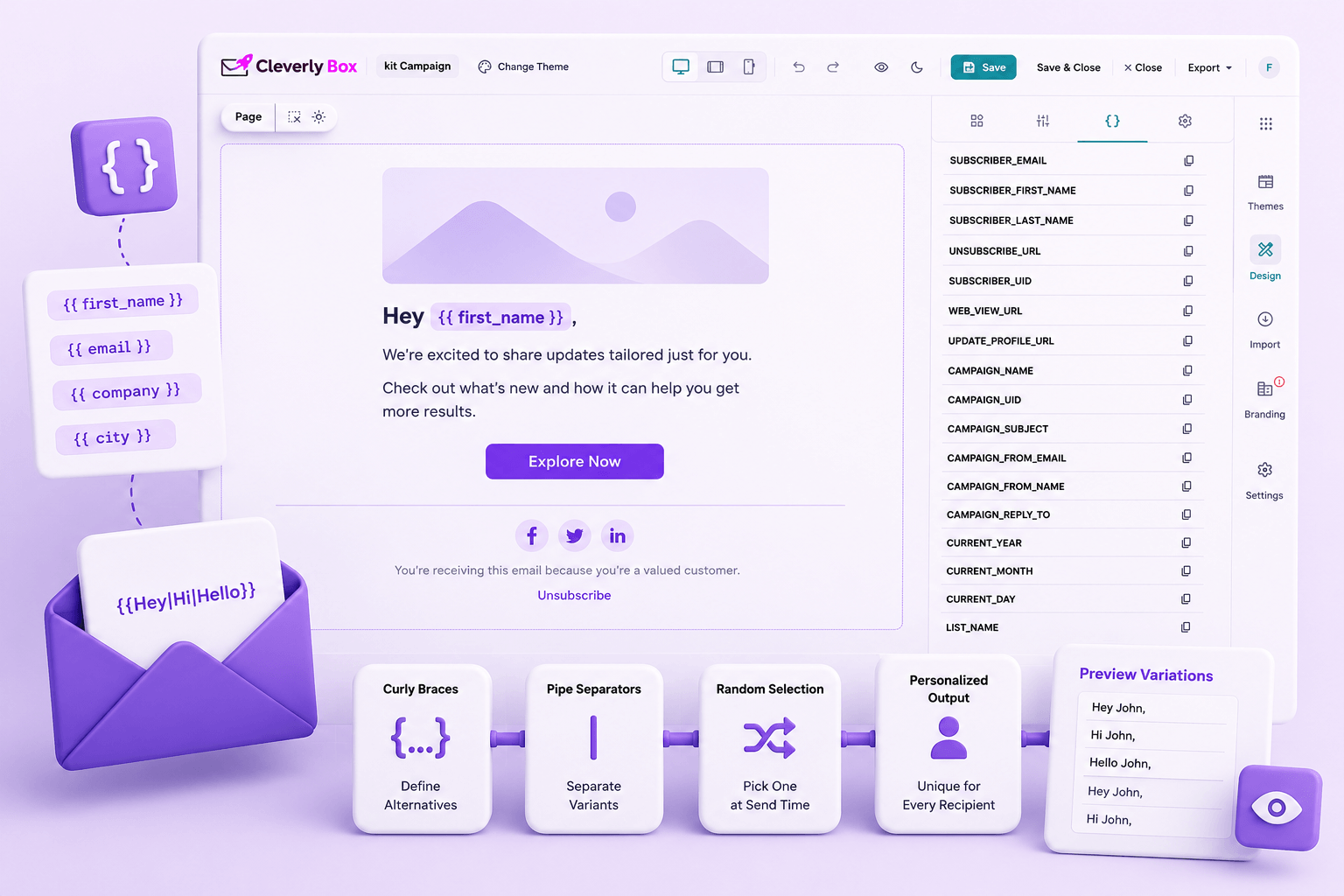
Wrap alternatives in curly braces, separate them with pipes. The platform picks one variant at random per recipient at send time. Works in subject lines, body copy, plaintext, and HTML anywhere text appears in the campaign.

  • Curly-brace + pipe syntax: {Hey|Hi|Hello}
  • Random selection per recipient at send time
  • Works in subject, preheader, body, HTML, plaintext
  • Combine with merge tags: {Hey|Hi} {{first_name}}
  • Spintax preview — see 5 sample renders before you send
  • Selection seeded by subscriber ID — same recipient gets the same variant on resend
Nested spintax

Spintax inside spintax. Combinatorial variation, no extra effort.

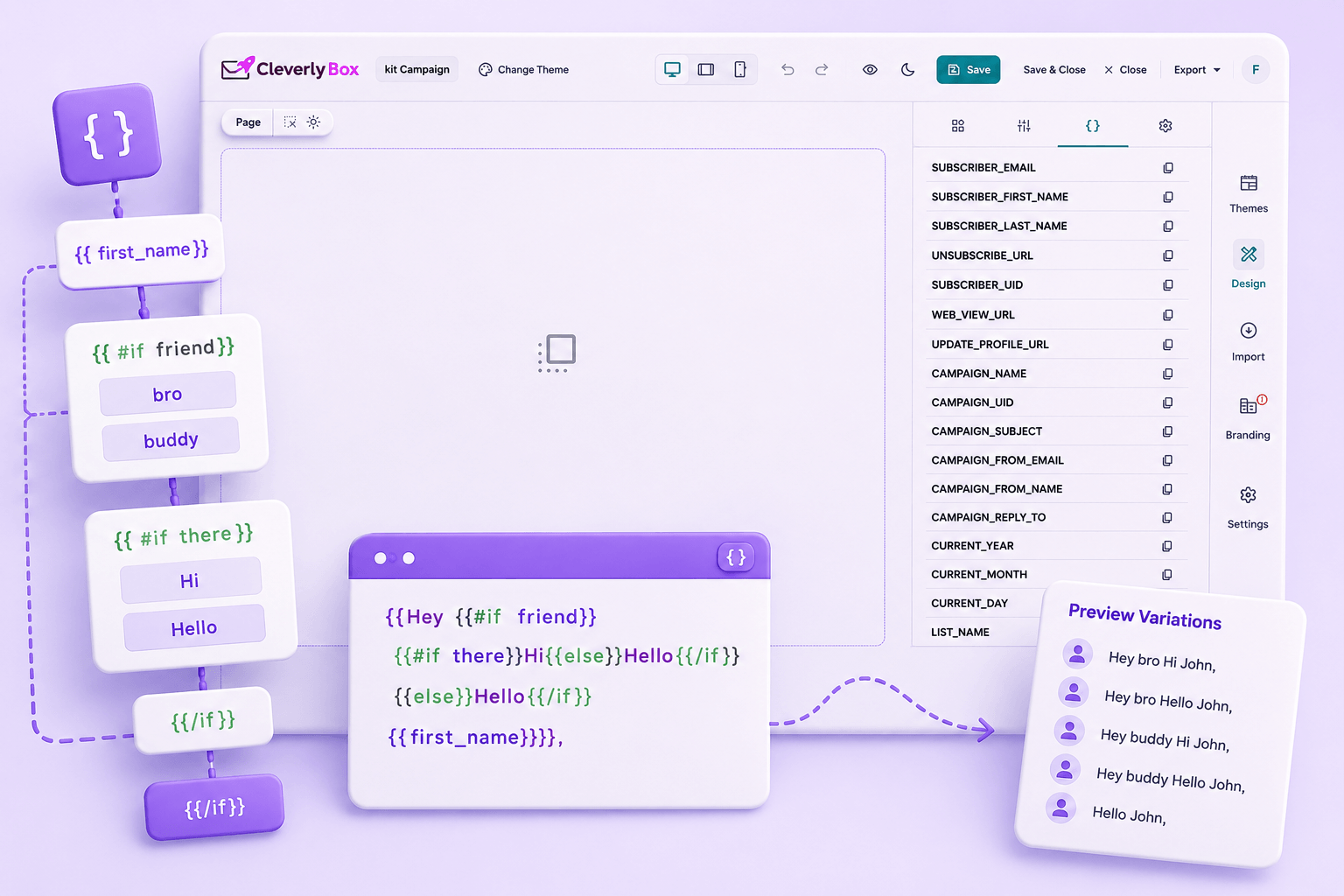
Variants can contain their own variants. {Hey {bro|friend}|Hi {there|{{first_name}}}|Hello} renders five distinct openings. Nest as deep as you need the platform recursively unwraps, picks at every level, and produces a final string.

  • Unlimited nesting depth
  • Nested variants pick independently at every level
  • Mix nested spintax with merge tags — both resolve at send time
  • Use to vary tone, formality, or detail per recipient segment
  • Preview tool unwraps nested combinations live
STRATEGIC PLACEMENT

Five places to drop spintax for oversized impact.

Not every line needs spintax. The five spots below give you 90% of the deliverability and engagement lift with the least authoring effort. Pattern them once, save them as snippets, reuse them across campaigns.

1. Cold-email opening

The most over-fingerprinted line in any cold campaign. Vary it.

2. Subject-line variation

Single biggest deliverability win. Even tiny variations break filter fingerprints.

3. CTA variation

Test phrasings without setting up A/B splits. Every recipient sees one of N.

4. Salutation variation

For lists where you can't match a first name, salutation tone still varies.

5. P.S. variation

High-engagement line in cold and nurture sends. Vary it for deliverability and persuasion impact at the same time.

VARIATION POWER

5 spintax lines × 4 alternatives = 1,024 unique combinations.

Spintax does the math. You get the performance. More variation = better deliverability and more replies.

AI COPYWRITER

Use the AI copywriter to generate the spintax variants.

Generate spintax-ready content in seconds.

Generate
AI + spintax

Use the AI copywriter to generate the spintax variants.

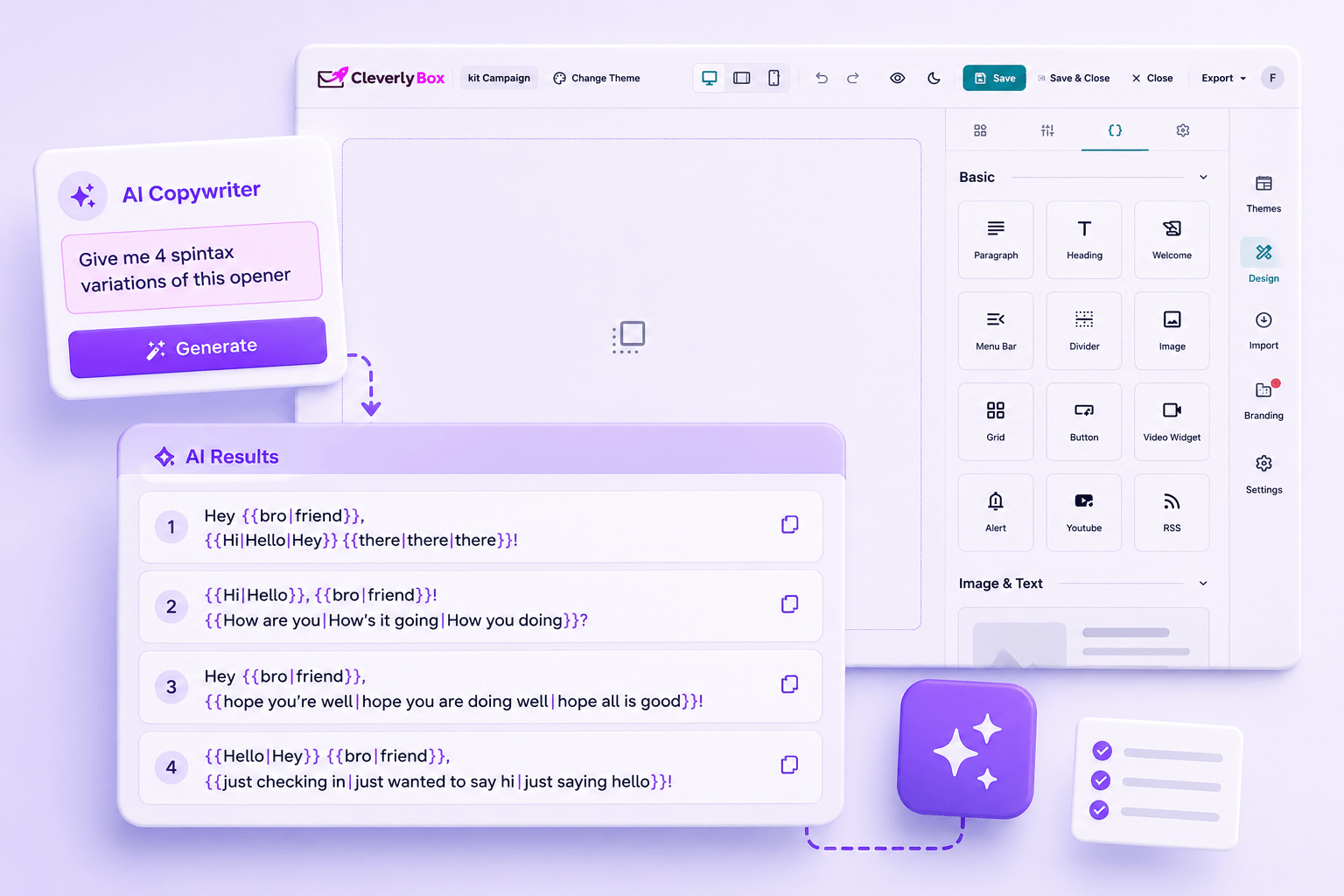
You don't have to brainstorm 4 alternatives for every line yourself. CleverlyBox's AI copywriter (GPT-powered) takes your base copy, generates spintax-formatted variations, and drops them straight into the editor. One prompt → ready-to-send spintax email.

  • Prompt the AI: "give me 4 variants of this opener as spintax"
  • AI returns ready-to-paste curly-brace formatted output
  • Vary by tone: formal / casual / urgent / friendly
  • Vary by length: short / medium / long versions
  • Save AI-generated spintax blocks as reusable snippets
  • Combine with manual edits — AI is the starting point, not the final word
Deliverability impact

Why spintax actually moves the inbox needle.

Content fingerprinting

ISPs hash the body of incoming mail. When 50,000 messages share a hash within minutes, that's a "campaign signature." Subsequent sends with the same hash get pre-classified to Promotions or Spam. Spintax breaks the hash every body is unique.

Subject-line clustering

Spam filters cluster subject lines that arrive in volume from the same sender. Identical subject = strong cluster signal = filter penalty. Spintax in the subject line eliminates the cluster signature without you A/B testing 20 versions.

Recipient engagement signal

When subject lines vary slightly, more recipients open (perceived freshness). Higher engagement = stronger sender reputation = better future placement. Spintax improves the second-order signal that drives Gmail's positive-engagement loop.

Volume-pattern detection

"Bulk send" detection looks at sending volume × content uniformity. High volume + identical content = bulk send. High volume + spintax-varied content = looks more like personalized 1:1 outreach to the filter which is treated more leniently.

MEASURE WHAT MATTERS

Two ways to vary a send. Spintax wins on scale.

Spintax creates thousands of natural variations. A/B testing helps you find what performs best.

Capability Traditional A/B
BEST
Spintax
Number of variants 2–3 typical 100s to 1,000s combinatorially
Setup overhead Build N versions, define test parameters Wrap text in {a|b|c|d}
Statistical significance ✓ measurable per variant ✗ variants too granular to test
Deliverability impact None — variants still fingerprint as bulk ✓ defeats content fingerprinting
Best for Headline / hero / CTA winner-finding Volume sends, cold email, deliverability
Combine with the other? ✓ A/B winner + spintax for the send ✓ Recommended pattern
FAQ

Questions about spintax, deliverability, and limits.

Merge tags substitute personalized data — {{first_name}} renders as Alex. Spintax randomizes wording — {Hey|Hi|Hello} renders as one of three options at random. They work together: {Hey|Hi} {{first_name}} gives "Hey Alex" or "Hi Alex" per recipient. Merge tags = personalization. Spintax = anti-fingerprinting variation.

Statistically, with 1,024 combinations across a 50,000-recipient send, you'd see each combination ~49 times. If you want guaranteed uniqueness on a smaller list, increase your spintax depth (more spintax lines, more alternatives per line). Selection is seeded by subscriber ID — so the same recipient gets the same variant on resend, which is good for consistency.

Yes — and this is where it has the biggest deliverability impact. Vary the subject line with 3–4 alternatives and you defeat subject-clustering at Gmail and Yahoo. We recommend always spintaxing the subject on volume sends. Preview tool shows you how the subject lines render across sample recipients before send.

Yes, unlimited depth. {Hey {bro|friend|{{first_name}}}|Hi} resolves recursively — outer pick first, then if a nested expression is selected, it picks within. Useful for varying tone (formal vs casual) inside a salutation, or for combining personalization with random openers.

No hard limit on spintax expressions per email. Practical limit: keep your raw source readable. Past about 8–10 spintax expressions per email, the source HTML becomes hard to maintain. Use the preview tool to verify rendered output and save commonly-used spintax blocks as snippets to reuse across campaigns.

Yes — the AI copywriter can both generate spintax variations from base copy ("give me 4 spintax variants of this opener") and write full spintax-aware emails when you prompt it that way. AI-generated spintax pastes directly into the editor in valid curly-brace + pipe syntax. Most users use the AI to seed variations, then manually edit for tone.

Yes. The preview tool generates 5 sample renders by default — pick subscriber records and see the email exactly as those recipients will receive it. Useful for catching syntax errors (unbalanced braces, etc.) and for sanity-checking the variation feels natural rather than templated.

No. They solve different problems. A/B testing finds the winning version with statistical significance — use it for hero sections, big subject-line tests, CTA copy, where the winner gets reused across campaigns. Spintax distributes content variation per recipient at send time for deliverability — use it on every volume send, especially cold and high-frequency newsletters. The best practice is: A/B test to find the winning structure, then spintax-vary the winner across the rest of the list.
DELIVERABILITY AT SCALE

One email. 1,024 versions. Inbox placement that actually holds up.

Curly braces. Pipe separators. Nested support. AI-generated variants. Subject + body + HTML aware. Built into every CleverlyBox campaign — Starter, Pro, and Agency.